“Lung mechanics and hypoxemia in COVID-19 patients with ARDS - News-Medical.Net” plus 2 more
“Lung mechanics and hypoxemia in COVID-19 patients with ARDS - News-Medical.Net” plus 2 more |
- Lung mechanics and hypoxemia in COVID-19 patients with ARDS - News-Medical.Net
- EWOT: 6 Effective Benefits- Oxygen Therapy for an Improved Quality of Life - newschannelnebraska.com
- Endothelial tissue injury significantly contributes to ARDS in COVID-19 patients, finds study - News-Medical.Net
| Lung mechanics and hypoxemia in COVID-19 patients with ARDS - News-Medical.Net Posted: 31 Jan 2021 07:21 PM PST Researchers have created a dataset of COVID-19 patients with acute respiratory distress syndrome to help characterize lung compliance and hypoxemia, which may help administer better treatments. The severity of COVID-19, the disease caused by the severe acute respiratory syndrome coronavirus 2 (SARS-CoV-2), ranges from no symptoms in some patients to severe disease, including death in others. Some patients require mechanical ventilation for respiratory failure and acute respiratory distress syndrome (ARDS). How COVID-19 related ARDS is different from other ARDS is still a subject of debate. Previous studies have small sample sizes and often do not have data on lung mechanics. To better understand how low blood oxygen level, or hypoxemia, and lung compliance varies in COVIDARDS and how they relate to disease outcomes, researchers developed a dataset of using more than 11,000 COVID-19 patients admitted to the hospital. A research paper published on the medRxiv* preprint server reports their results. .jpg "Study: Trajectories of Hypoxemia & Respiratory System Mechanics of COVID-19 ARDS in the NorthCARDS dataset. Image Credit: NIAID") COVIDARDS datasetThe authors performed a retrospective study of mechanically ventilated COVID-19 patients admitted to New York City hospitals between 1 March 2020 and 30 April 2020. They included oxygen saturation, fraction of inspired oxygen, static and dynamic lung compliance in their dataset and investigated different characteristics of COVIDARDS. Of the more than 3,000 patients the team identified who were mechanically ventilated, 2020 were COVID-19 positive and 1,554 met the criteria the team set for inclusion in the study, which included reliable lung compliance data. They found the average lung compliance was 24.44. mL/cm H2O. About 34.6% of the patients had deficient lung compliance, less than 20 mL/cm H2O, 63.2% with low-normal compliance (20-50 mL/cm H2O), and 2.2% had high compliance (more than 50 mL/cm H2O). The patients' average age was 65 years, 32% were females, and 35% were white. There were more females in the very low compliance group and a larger proportion was non-white or multiracial. The most common co-morbidities were hypertension and diabetes. Almost all the patients were given hydroxychloroquine. About 83.5% of the patients in the very low compliance category and about 77% in the low-normal group received at least one vasopressor during the first two days. COVIDARDS patients were intubated on average in about two days of admission and were intubated for an average of 14 days. The mean oxygen index 24 hours after intubation was 11.1 and a little worse for patients in the very low compliance category. They found that lung compliance decreased with time in all the patients. Of the 1554 patients, 67.5% died in the hospital, with the very low compliance group having the highest deaths. Lung compliance not the same across patientsOf particular note in the dataset was the longer timer to intubate patients with very low lung compliance, the steeper decrease in compliance among those who died, and severe hypoxemia in high lung compliance. It is possible that ARDS patients may have started out with normal lung compliance, which became worse with the disease or the treatments. Long exposure to high oxygen may contribute to low compliance in intubated patients. High oxygen has been shown to cause lethal lung injury in animals. Or, severe inflammation because of the disease could have led to lower compliance. Further studies that measure compliance over time before intubation and the progression of ventilation may help shed more light. The ratio of oxygen partial pressure and fraction of inspired oxygen (P/F) improved after intubation in all groups, from a mean of 109 to 155. The very low compliance category showed the lowest improvement. However, the team did not see any correlation between the P/F ratio and lung compliance. Although there have been questions about whether COVIDARDS should be treated differently than non-COVID ARDS, the authors write a more pertinent question would be if ARDS management should be different for patients with different lung compliance. An index that accounts for oxygen impairment and compliance over time may help doctors tailor treatments better. The about 2% of patients in the high compliance group was lower than the 12% reported in a recent study of non-COVID ARDS patients, who did not receive ventilation until many days after hospital admission. So comparisons between studies should account for the timing of intubation. Although the study's strength is its large sample size, one of the limitations is that it was a retrospective study and factors that influenced decisions to intubate could not be controlled. However, the dataset will help understand COVIDARDS further and provide treatment appropriately. *Important NoticemedRxiv publishes preliminary scientific reports that are not peer-reviewed and, therefore, should not be regarded as conclusive, guide clinical practice/health-related behavior, or treated as established information. Journal reference: |
| EWOT: 6 Effective Benefits- Oxygen Therapy for an Improved Quality of Life - newschannelnebraska.com Posted: 31 Jan 2021 06:42 AM PST
 WN Lifestyle Home - Health Photo From ewot Originally Posted On: https://www.ewot.com/blogs/blog/ewot-6-effective-benefits-of-exercise-with-oxygen-therapy-for-an-improved-quality-of-life  According to The Global Impact of Respiratory Disease, respiratory diseases are among the leading causes of death worldwide. It's estimated that over a billion people suffer from acute and chronic diseases. Respiratory diseases cause an array of symptoms, but one of the most common is difficulty breathing. Difficulty breathing can lead to psychological stress and limit physical activity. One method of combating these diseases and improving your quality of life is experimenting with EWOT (Exercise with Oxygen Therapy). Keep reading to learn all about the basics of EWOT as well as six potential health benefits.
EWOT EXPLAINEDThe air we breathe is about 21% oxygen. The body uses oxygen to supply cells with energy so they can carry out basic functions. The purpose of EWOT is for the body to breathe in higher concentrations of oxygen than it normally receives. The best way to do "EWOT" is to use a Maxx O2 System. These systems consist of an oxygen concentrator, which generates increased supplies of purified oxygen. The oxygen is contained in a bag that is connected to a mask that delivers oxygen during exercise. This influx of oxygen leads to a host of health benefits.
1. ATHLETIC PERFORMANCEOne of the most compelling benefits of oxygen therapy is that it enhances athletic performance. Athletes performing at intense levels require large amounts of ATP. ATP is the body's source of energy, which is produced with the help of oxygen. When an athlete has greater levels of ATP, it improves their stamina and endurance. EWOT can be achieved with a variety of fitness equipment, like treadmills, ellipticals, and bikes.
2. MUSCLE RECOVERYWhen the body runs out of energy or oxygen to generate energy, it creates lactic acid. Lactic acid build-up leads to fatigue. It can also cause muscle pain or cramping. Higher oxygen levels reduce fatigue and boost the recovery rate of muscles after intense exercise.
3. IMPROVE CIRCULATIONFatigue, cramps, cold hands and feet, or difficulty concentrating are all symptoms of poor circulation. Circulation is important for maintaining normal functioning in the body. Oxygen Therapy strengthens the blood flow and improves circulation.
4. BETTER IMMUNE SYSTEMAs the body's blood circulation improves, so does the immune system. Circulation is necessary for supplying the body with blood. Blood transports essential nutrients as well as blood cells and platelets. White blood cells are crucial for helping the body fight infection. Platelets repair damages in the body by helping blood clot.
5. ENHANCED BRAIN FUNCTIONINGThe brain needs a constant supply of oxygen to work properly. In addition to benefiting physical performance, oxygen therapy benefits mental performance. Higher levels of oxygen in the brain may improve cognitive functioning. This includes information processing, decision making, memory, and concentration. As oxygen enhances brain functioning, it also promotes better sleep. Studies suggest that exposure to high levels of oxygen may lead to deeper, more restorative sleep. High quality sleep allows the body to heal and prepare for activity each day.
TAKE A BREATHEWOT benefits the health and well-being of all individuals. Whether you're an athlete looking to improve performance or someone that suffers from respiratory disease, oxygen therapy is worth trying out! Information contained on this page is provided by an independent third-party content provider. Frankly and this Site make no warranties or representations in connection therewith. If you are affiliated with this page and would like it removed please contact pressreleases@franklymedia.com |
| Posted: 12 Jan 2021 12:00 AM PST A recent study conducted by scientists from the Yokohama City University, Japan, has revealed that elevated alveolar endothelial injury markers in coronavirus disease 2019 (COVID-19) patients with acute respiratory distress syndrome (ARDS) are the main causative factors for alveolar barrier disruption. In COVID-19 patients with ARDS, endothelial injury persists for a longer time than epithelial injury. The study is currently available on the medRxiv* preprint server.  BackgroundThe COVID-19 pandemic caused by severe acute respiratory syndrome coronavirus 2 (SARS-CoV-2) has put a lot of burden on the healthcare and socioeconomic structures of many countries worldwide. Although a significant portion of COVID-19 patients remain asymptomatic or mildly symptomatic, the disease can contribute to serious complications in susceptible individuals. In its severe form, COVID-19 has been found to associate with ARDS. The presence of severe lung edema, together with alveolar epithelial and endothelial injuries, is the primary pulmonary characteristics of COVID-19 patients with ARDS. To develop effective therapeutic interventions, it is important to understand how alveolar tissue injury markers contribute to the pathogenesis of ARDS associated with COVID-19. Current study designThe scientists have enrolled COVID-19 patients with or without ARDS for this study. They have used serum samples obtained from these patients to measure the levels of alveolar epithelial and endothelial injury markers, namely soluble receptor for advanced glycation end-products (sRAGE) and angiopoietin-2 (ANG-2), respectively. In addition, the serum level of surfactant protein D (SP-D), which is a marker of alveolar barrier permeability, was measured. In addition to comparing the levels of these markers between COVID-19 patients with or without ARDS, the scientists analyzed how the levels vary with time. Important observationsOf 9 COVID-19 patients with ARDS, 3 died during the study period; whereas all COVID-19 patients without ARDS (a total of 8 patients) survived. The clinical characteristics of ARDS patients have shown that the lungs are the primary organ to be affected by the disease. Of all ARDS COVID-19 patients, only one has developed acute kidney disease. The biochemical analysis data reveal elevated serum levels of all alveolar tissue injury markers at the initial phase in both ARDS and non-ARDS COVID-19 patients. In COVID-19 patients with ARDS, a surge in the level of epithelial injury marker has been observed just after hospital admission; whereas, the peak levels of endothelial injury marker and alveolar barrier permeability marker have been observed during the later phase of the disease. These findings indicate that while alveolar epithelial injury occurs at the initial phase of the disease, endothelial injury continues for a longer time. With further analysis, the scientists have observed that the circulating level of endothelial injury marker positively correlates with the level of alveolar barrier permeability marker and negatively correlates with the ratio of arterial oxygen partial pressure and fraction of inspired oxygen. However, an inverse correlation has been observed between epithelial injury marker and alveolar barrier permeability marker. 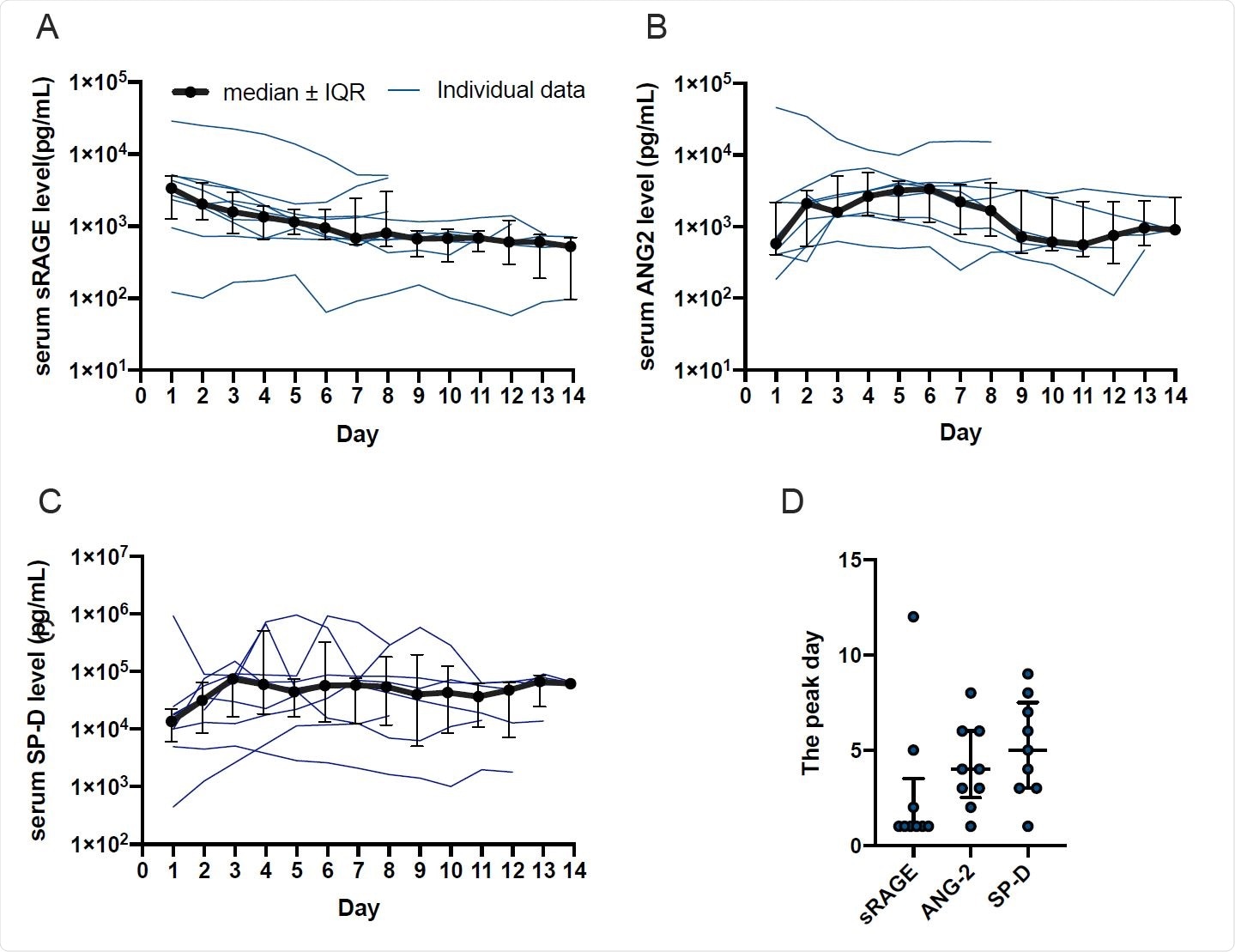 Temporal changes of (A) sRAGE, (B) ANG-2, and (C) SP-D levels in ARDS patients with COVID-19 for 14 days starting from admission. (D) The peak day of each of the alveolar tissue injury markers. Data were presented as median ± IQR. Study significanceTaken together, the study indicates that alveolar barrier tissue injury is one of the major features of ARDS associated with COVID-19. In COVID-19 patients with ARDS, damage to the alveolar epithelial tissue peaks at an early stage even before the hospital admission. In contrast, alveolar endothelial injury peaks at later stages of the disease and persists for several days after hospital admission. Another important observation made in this study is that endothelial tissue injury is the main causative factor for alveolar permeability disruption in COVID-19 patients with ARDS. The scientists believe that SARS-CoV-2-mediated endothelial injury might be responsible for lung vascular thrombosis observed in COVID-19 patients. Based on the overall study findings, the scientists suggest that therapeutic alleviation of endothelial injury rather than epithelial injury might be more effective in treating COVID-19 patients who also suffer with ARDS. *Important NoticemedRxiv publishes preliminary scientific reports that are not peer-reviewed and, therefore, should not be regarded as conclusive, guide clinical practice/health-related behavior, or treated as established information. Journal reference: |
| You are subscribed to email updates from "respiratory diseases,respiratory distress,respiratory distress symptoms" - Google News. To stop receiving these emails, you may unsubscribe now. | Email delivery powered by Google |
| Google, 1600 Amphitheatre Parkway, Mountain View, CA 94043, United States | |

Comments
Post a Comment